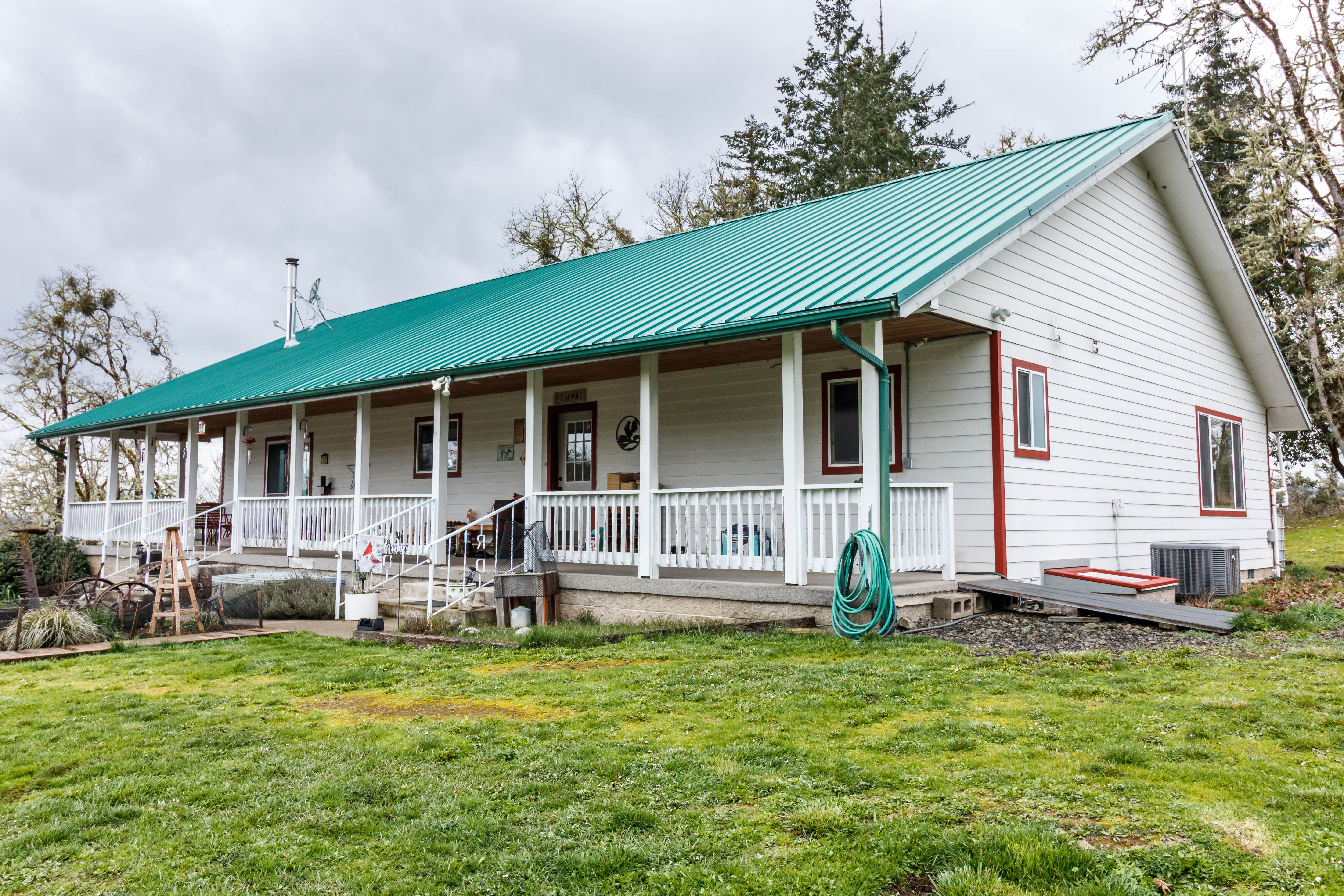
Get Your Home Market-Ready. Pay at Closing.
Aaron coordinates and funds the repairs and improvements your home needs — from minor fixes to major capital projects. You pay nothing out of pocket until the sale closes.
Designed for Sellers Who Want to Compete Without the Burden
This service is designed to help sellers maximize their property’s value and marketability without the burden of upfront costs or the complexity of managing construction projects.
Through this program, I coordinate and oversee necessary repairs and improvements — ranging from minor appraisal-required fixes to major capital projects such as roofing, well and septic systems, foundation work, and more. I work directly with trusted local contractors, including electricians, plumbers, excavation crews, and specialty trades, to ensure the work is completed properly, efficiently, and in alignment with market expectations.
In many cases, I will advance funds to cover part or all of the improvement costs. These expenses are then reimbursed through escrow at closing. This approach allows sellers to unlock their property’s full potential, reduce days on market, and position their home competitively — without needing to access cash or take on additional financial strain prior to the sale.
Program Eligibility
This program is offered on a case-by-case basis. Eligibility depends on the property itself — its condition, location, and projected return on investment — as well as Aaron’s assessment of how he can best serve the client’s goals. Not every property or situation is the right fit, and Aaron will tell you honestly whether this program makes sense for your specific circumstances before any commitment is made.
Three Steps to a Market-Ready Home
Assessment
Aaron walks the property and identifies every repair and improvement that affects value or marketability — separating must-fix items from strategic upgrades.
Coordination
Aaron engages licensed local contractors, manages timelines, verifies scope and quality, and handles communication between all parties involved.
Reimbursement at Closing
Improvement costs advanced by Aaron are repaid through escrow at closing. You receive your net proceeds after all costs are settled.

From Minor Fixes to Major Projects
Appraisal-Required Repairs
Items that lenders’ appraisers call out as conditions of financing. These must be completed before a deal closes. Left unaddressed, they can kill a transaction or create last-minute renegotiation pressure.
- Broken windows, damaged doors, missing hardware
- Faulty GFCI outlets, exposed wiring, panel deficiencies
- Active roof leaks and water intrusion points
- Missing or damaged handrails and safety guards
- Peeling paint on older homes (FHA/VA requirement)
- Health and safety hazards flagged by inspectors
Capital Improvement Projects
Larger projects that meaningfully increase market value, reduce buyer objections, and position the property to attract full-price offers and fewer post-inspection concessions.
- Full roofing replacements and repairs
- Well pump installations and water system repairs
- Septic system repairs and complete replacements
- Foundation repair and structural remediation
- HVAC replacement and heating system upgrades
- Exterior paint, siding repair, and curb appeal improvements

Strategic Positioning
“Most sellers don’t leave money on the table because they priced wrong. They leave it because they couldn’t get the home ready.”
— Aaron Cherry, Real Estate Broker, Douglas County
Why Condition Drives Results in This Market
In Douglas County, the average home sits on market for 43–45 days before going pending, with roughly 3.5 months of active inventory. In that environment, condition is a primary differentiator. Buyers have options, and they will gravitate toward the property that requires the least post-close work and financial uncertainty.
A home that passes inspection cleanly, appraises at or above contract price, and presents well in photographs will consistently outperform comparable properties that require negotiation and concessions. The Strategic Improvement Program exists to put your home in that position before it ever hits the MLS. Start with a free home valuation to understand your baseline.
What a Market-Ready Home Achieves
Fewer post-inspection concession demands from buyers
Reduced risk of appraisal conditions derailing a transaction
Stronger first-week showings and faster offer activity
Buyers competing rather than negotiating
Higher net proceeds after improvement costs are deducted
Shorter time on market with less seller carrying cost
Strategic Improvement Program — Frequently Asked Questions
Just about anything that affects marketability or appraised value. On the minor end, that includes appraisal-required repairs — things like broken windows, faulty GFCI outlets, exposed wiring, trip hazards, or peeling paint on older homes. On the major end, I've coordinated full roofing replacements, well pump installations, septic system repairs and replacements, foundation work, HVAC upgrades, and exterior paint or siding. The determining factor is whether the improvement meaningfully affects your net proceeds. If spending $8,000 on a roof gets you $20,000 more at closing, the math is straightforward. If the improvement doesn't move the needle, I'll tell you that too.
I advance part or all of the cost of the improvements upfront — either directly to the contractor or into a project account. You don't write a check, you don't take out a loan, and you don't need to tap a line of credit. When the sale closes, the amounts I've advanced are reimbursed through escrow before you receive your net proceeds. It's structured as part of the listing agreement, and everything is documented in writing before a dollar is spent. This isn't a vague handshake arrangement — the scope, the cost, and the repayment terms are all spelled out clearly.
Local, licensed, and vetted. I work with contractors I've built relationships with over years of transactions in Douglas County and the surrounding area — electricians, plumbers, excavation crews, roofers, and specialty trades. These aren't people I found online. They're people whose work I've seen, whose timelines I've tested, and who understand that a real estate transaction has a closing deadline. I don't use the cheapest option — I use the most reliable option, because a botched repair that fails inspection or creates a disclosure issue costs far more than the money saved.
An appraisal-required repair is something a lender's appraiser will call out as a condition of financing — meaning the deal can't close until it's fixed. Common examples include missing handrails, broken HVAC, active roof leaks, deteriorated siding, or health and safety items. These are non-negotiable if your buyer is using conventional or FHA financing. A capital project is a larger improvement that isn't necessarily required by an appraiser but meaningfully increases your property's market value or reduces days on market — a new roof, a well pump, a septic replacement, foundation repair. Both types qualify for this program. The difference is urgency: appraisal items can stop a transaction cold, while capital projects are strategic.
The main risk is that the property doesn't sell, or that it sells for less than anticipated. If a sale falls through entirely and the listing expires, the repayment terms for any advanced funds would be addressed per the listing agreement — which I'll walk you through in detail before any work begins. I'm not going to advance $40,000 on a property where the math doesn't support it. Part of my job is making sure the improvements we select have a clear, documented return on investment based on comparable sales. I'm not in the business of speculating with your equity.
Significantly, in most cases — and the impact goes beyond just sale price. A home that's move-in ready sells faster, attracts more competitive offers, and is less likely to face low appraisals or renegotiation after inspection. In the Douglas County market, where the average sold price is around $354,000, a $10,000–$15,000 investment in strategic improvements can often yield $20,000–$40,000 more in net proceeds, while also reducing the time on market by weeks. That's not a guarantee — every property is different — but the pattern is consistent enough that I don't offer this program lightly.
Related Services
Ready to Talk About Getting Your Home Ready?
Call or email Aaron to discuss your property. He’ll walk through what improvements would have the highest impact — and whether this program makes sense for your situation.
The Strategic Improvement Program is offered at Aaron Cherry’s sole discretion on a case-by-case basis. Participation depends on the property’s condition, location, projected return on investment, and Aaron’s professional assessment of how he can best serve the client. Not all properties or clients will qualify. All terms are documented in writing prior to any work beginning.